Digastric: Pain Pattern and Treatment
The digastric is a two-bellied muscle under the jaw, running from behind the ear to the chin with a sling at the hyoid bone in between. It opens the jaw and lifts the throat in swallowing. Its documented pattern has two parts: from the back belly, pain in the upper neck and behind the ear, with a throat that feels sore or catches when swallowing; from the front belly, pain in the four lower front teeth. It is the muscle behind a lump-in-the-throat feeling with normal scopes, and behind lower incisors that ache with nothing on the X-ray. It relates to the masseter and sternocleidomastoid pages.
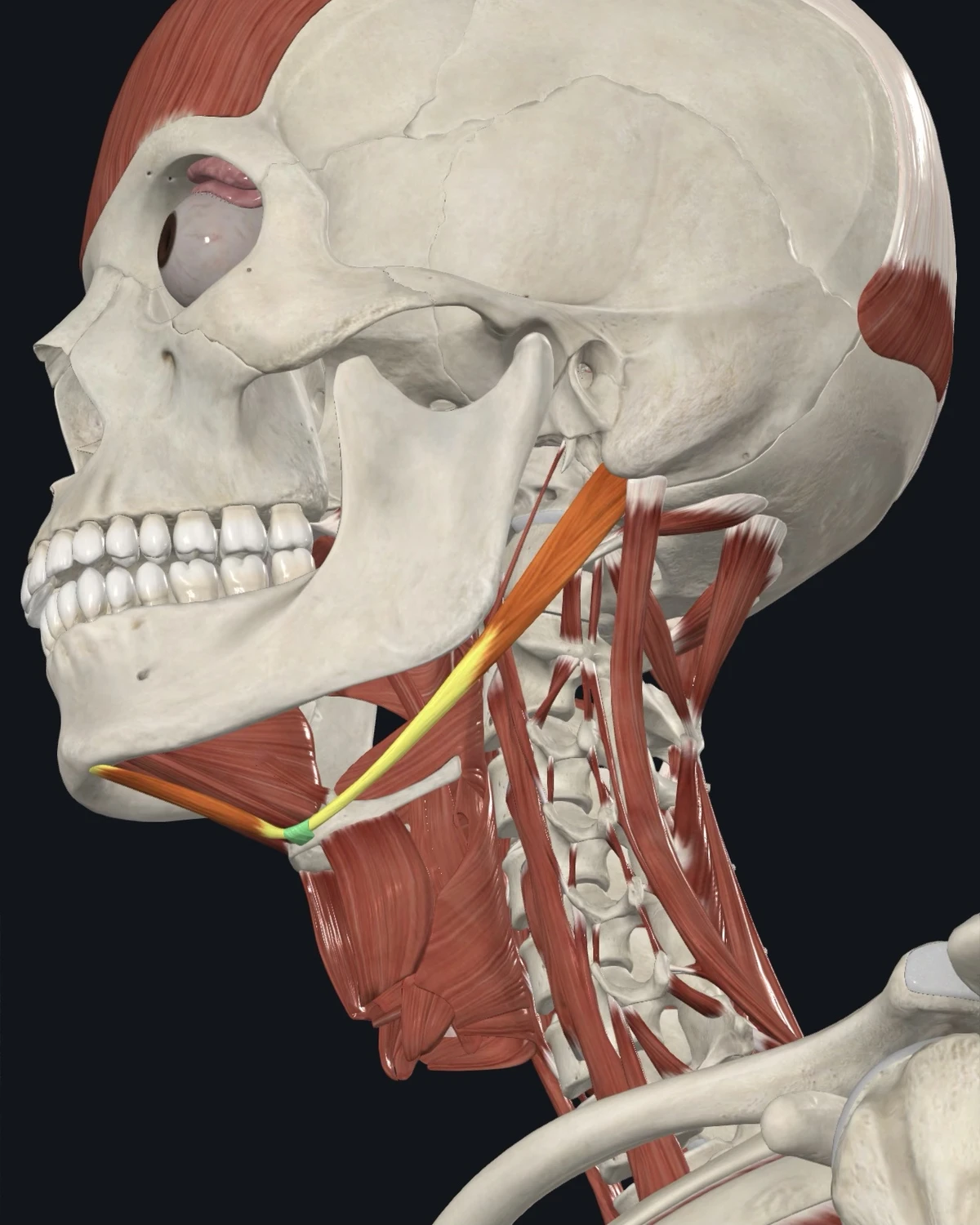
Attachments and action
Origin: Posterior belly: the mastoid notch of the temporal bone. Anterior belly: the digastric fossa on the inside of the chin.
Insertion: Both bellies meet at an intermediate tendon held to the hyoid bone by a fibrous sling.
Action: Depression of the jaw when the hyoid is fixed; elevation of the hyoid in swallowing; the posterior belly pulls the hyoid back and up.

Where the pain is felt: In the upper neck below and behind the ear, over the top of the sternocleidomastoid. Behind the ear at the mastoid. In the four lower front teeth, from the front belly. A throat that feels sore or has a lump in it, worst swallowing.
Common causes: Mouth breathing; clenching and grinding; a retruded chin posture; playing a wind instrument; a long dental appointment with the mouth held open; whiplash; a habit of pulling the tongue back; forward-head posture.
Patients say: "My lower front teeth ache and the dentist found nothing." "It feels like a lump in my throat." A sore throat that no infection explains. "Under my jaw is tender to press."
When to get evaluated: A lump in the neck you can feel, swallowing that is getting harder, weight loss, hoarseness for more than three weeks, or a sore throat with fever needs medical evaluation first. Tooth pain with swelling, heat, or a bad taste needs a dentist for an abscess before anything else.
How this muscle is examined and treated
Examination tests jaw opening against resistance and watches the swallow, then presses under the jaw behind the chin for the front belly and below the ear behind the jaw angle for the back belly, for the points that reproduce the tooth and throat symptoms. Needling here addresses the two bellies under the jaw, the back belly with the vessels behind the jaw respected. Assessment and treatment happen in the same visit.
Related conditions
Headaches & MigrainesNeck & Cervical PainChronic Pain Patterns
This page is educational. It describes muscle referral patterns commonly associated with pain; it does not diagnose your condition. Individual patterns vary. For evaluation of your specific pain, see a licensed clinician. Seek immediate medical care for emergencies. Eugene Baek, L.Ac. · New Jersey License 25MZ00080600