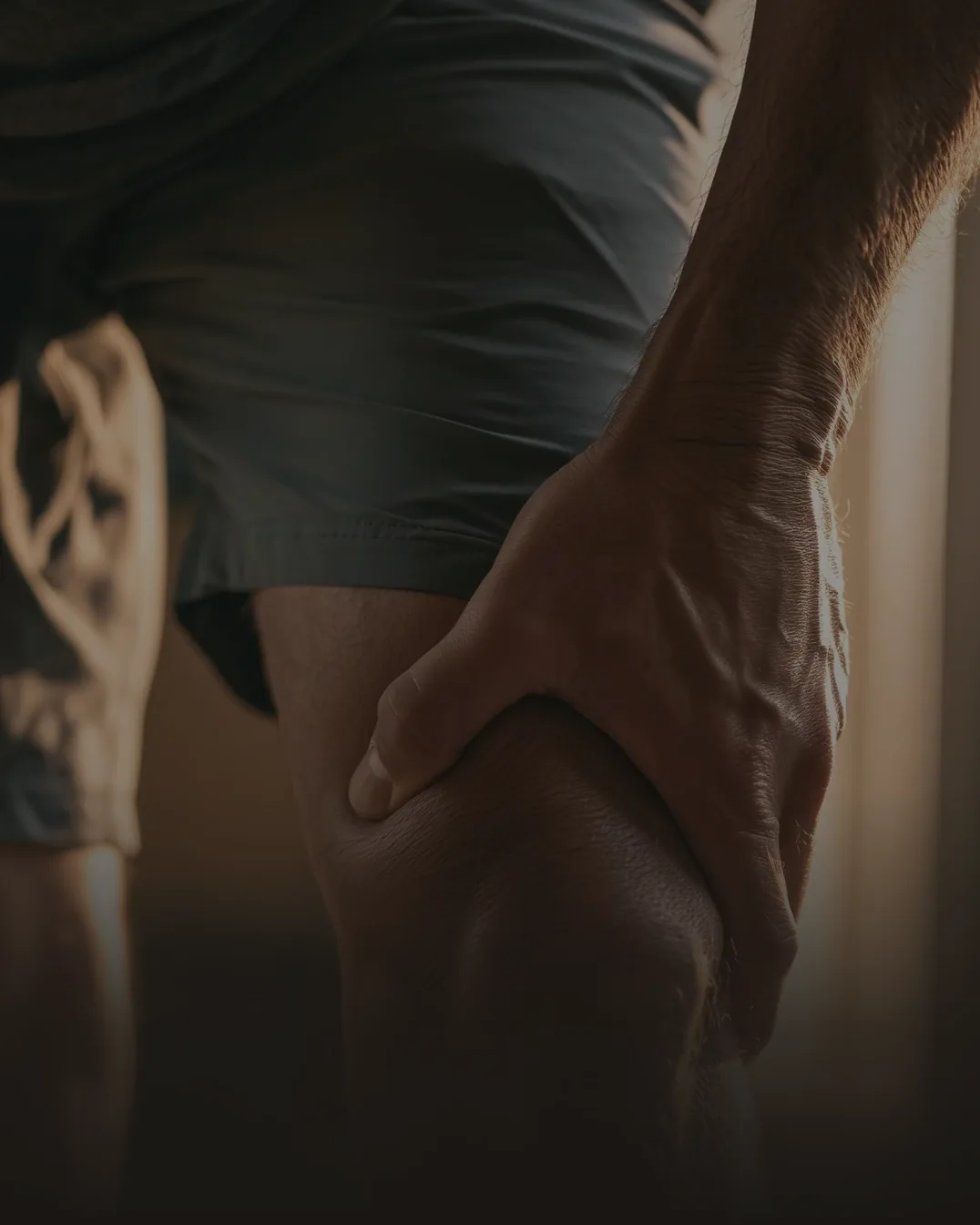
Knee pain relief that starts
at the first visit.
Dry needling and acupuncture in one visit, releasing the quadriceps, hamstrings, and gastrocnemius that refer pain into the knee.
5.0 · 62 reviews on GoogleTreated, you take the stairs, kneel on the floor, and get up from a low chair without thinking about it.
Seek urgent medical care first for:
a hot, red, swollen knee with fever,
a knee you cannot put weight on after an injury,
a knee that locks or gives way,
sudden large swelling within hours of an injury,
or calf swelling and warmth below the knee.
First visits are typically $300, follow-ups $250. Acunatomy is out-of-network with all plans; HSA and FSA cards are accepted, and a superbill is provided for reimbursement. Coverage and costs, explained.
"I’ve had bursitis for a while and PT wasn’t helping too much. Only after receiving acupuncture treatment once a week for about three weeks, I was back to running my normal mileage volume with no pain or discomfort at all. Eugene knew exactly where the pain was coming from. He explained in a very detailed manner how the treatment was going to help me — and it certainly did."
Does acupuncture help knee pain?
Yes. Across 39 trials and 20,827 patients, acupuncture beat sham treatment for knee osteoarthritis, and the benefit held at one year. Trigger points in the quadriceps, hamstrings, popliteus, and gastrocnemius refer pain into the joint and compress it. Dry needling releases those muscles and acupuncture reduces the pain and inflammation.
Vickers et al., Journal of Pain, 2018
A typical treatment timeline.
Pain on stairs and squats typically drops between visits.
What resolution looks like for your knee.
Stairs one at a time, good leg first.
Any leg, any staircase.
Icing after ordinary days.
Ice pack retired.
Bracing before you stand.
Up like it’s nothing.
Common questions about knee pain treatment.
Yes. Acupuncture is among the best-studied treatments for knee osteoarthritis: in pooled data from 20,827 patients it reduced pain more than sham treatment, and the effect held at one year. Dry needling releases the quadriceps, hamstrings, and gastrocnemius that compress an arthritic knee. It does not reverse cartilage loss; it reduces the pain and restores movement.
Yes. Intermittent pain is the early form of a pattern that is building. Muscles around the knee, particularly the vastus medialis, IT band, and popliteus, develop trigger points that flare with activity and quiet with rest. Treating it while intermittent takes fewer visits than waiting for it to become constant.
Yes, in two ways: reducing pain while you decide, and clarifying how much of the pain is muscular and how much is the joint. Some patients scheduled for replacement find that trigger points, not the joint, were producing much of their pain. That does not always make surgery unnecessary, but it sharpens the decision.
Knees take the load of problems that start elsewhere. Quadriceps and IT band trigger points change how the kneecap is loaded, and weak quadriceps let the joint absorb force the muscle should have taken. Pain without an injury means accumulated mechanical stress, and the treatable part is in the muscles above the knee.
Yes, routinely. The knee sits between two joints it depends on: hip dysfunction changes the load the knee receives, and nerve irritation in the low back refers pain to the knee. Treating only the spot that hurts misses that, so the first-visit assessment examines the hip and back as well.
Going down loads the quadriceps while they lengthen, and the popliteus unlocks the knee at each step. Trigger points in both refer pain with exactly that motion, so a knee that climbs fine and hurts on the way down points to those muscles. Both are treated at the first visit.
Runner’s knee is pain around or behind the kneecap with sitting, stairs, and squats, typical in active people under 50. Osteoarthritis is pain along the joint line with stiffness after rest, more common after 50. Both respond to needling the same muscles; the assessment tells you which you have.
Where does it hurt?
Or find it on the body →Your knee can
take weight again.
Let’s restore it.
5.0 · 62 reviews on Google
Out-of-Network Insurance Accepted: Horizon BCBS · Oxford · UnitedHealthcare · Cigna · Aetna · Self-Pay Available