Latissimus Dorsi: Pain Pattern and Treatment
The latissimus dorsi is the broad sheet of muscle spanning the mid and lower back to the arm. Its trigger points produce a constant ache at the lower tip of the shoulder blade that changes with nothing (not position, not activity, not rest). That indifference to movement is why the latissimus is easily worked on in the wrong place.
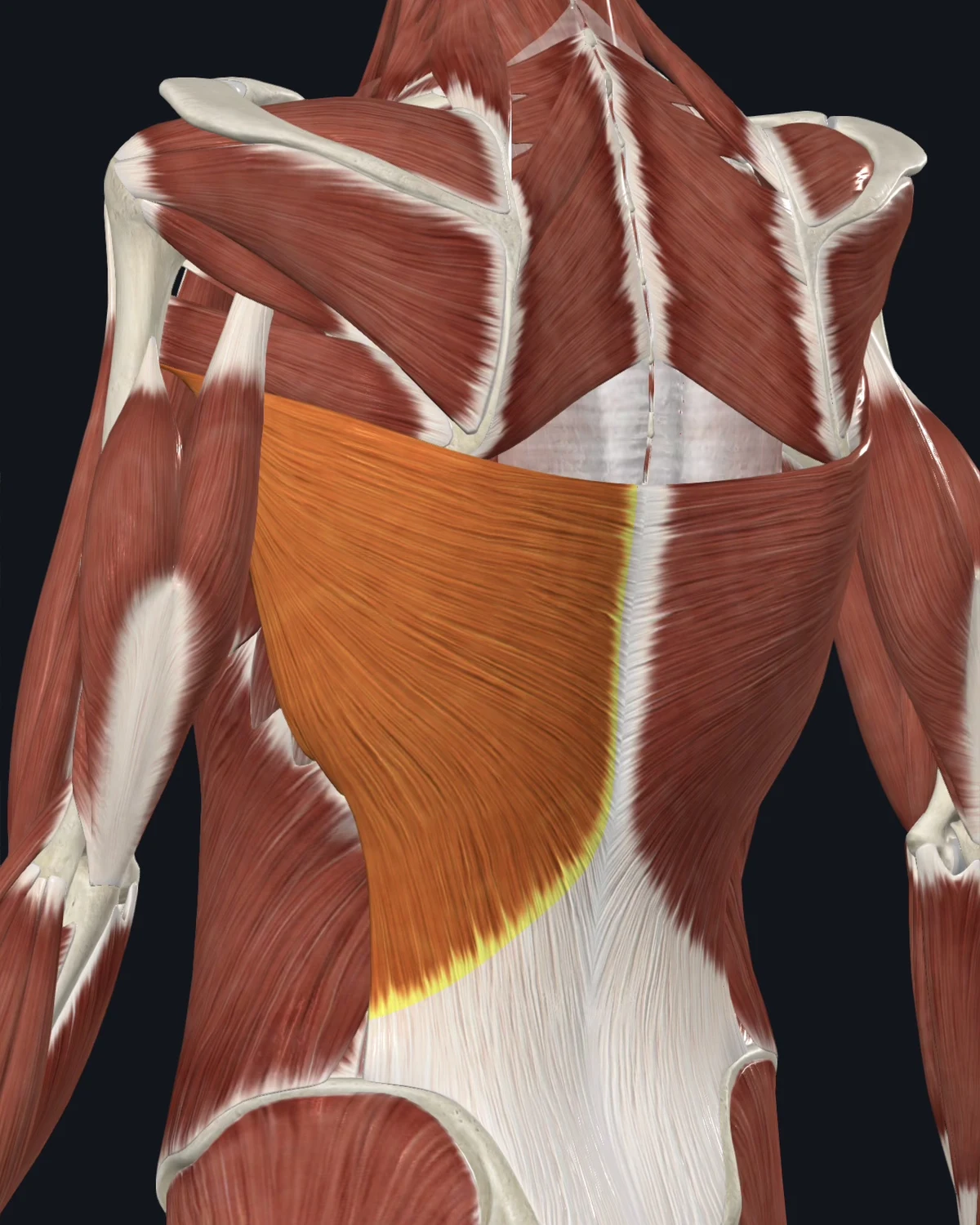
Attachments and action
Origin: The spinous processes of T7 through L5, the thoracolumbar fascia, the iliac crest, and the lower ribs.
Insertion: The floor of the bicipital groove of the humerus.
Action: Extension, adduction, and internal rotation of the arm. This is the pull-up and swimming muscle, which is why reaching up and forward can provoke the pattern.
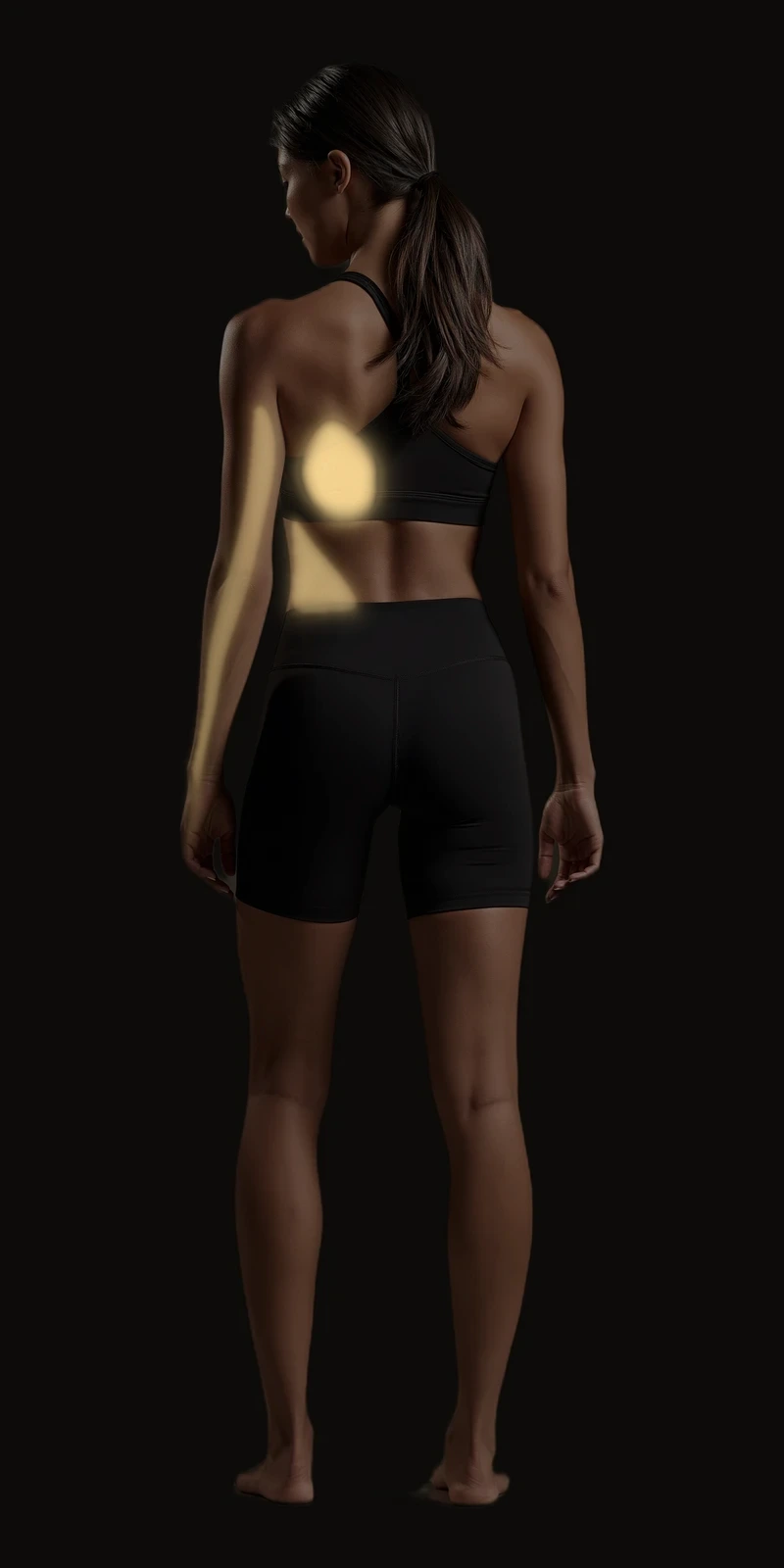
Where the pain is felt: The axillary trigger point refers a steady ache to the inferior angle of the shoulder blade and the mid-back around it, spilling to the back of the shoulder and down the inner arm to the ring and little fingers. The lower point refers to the flank, from the free border of the muscle down to the crest of the pelvis. On the figure, the solid zone runs from below the blade tip down the flank; the arm line traces the inner arm to the little-finger edge of the hand.
Common causes: Pull-ups, rowing, and swimming; carrying loads overhead or reaching up and forward repeatedly; an unsupported arm during long computer work; gripping a wheelchair or walker.
Patients say: “There’s a constant ache at the bottom of my shoulder blade that nothing changes.” Some also describe pins-and-needles running down the inner arm into the ring and little fingers.
When to get evaluated: Mid-back pain that is constant and progressive at night, or arm symptoms with weakness or grip loss, warrant physician evaluation to rule out cervical nerve root involvement before treatment.
How this muscle is examined and treated
Examination distinguishes this pattern from a pinched neck nerve: latissimus referral does not follow a single nerve root, and neck movement does not change it. Pressing the muscle’s free border at the back edge of the armpit reproduces the mid-back ache, a confirmation that often surprises patients. Needling addresses the axillary and flank points directly. Assessment and treatment happen in the same visit.
Related conditions
Shoulder DysfunctionNeck & Cervical PainChronic Pain Patterns
This page is educational. It describes muscle referral patterns commonly associated with pain; it does not diagnose your condition. Individual patterns vary. For evaluation of your specific pain, see a licensed clinician. Seek immediate medical care for emergencies. Eugene Baek, L.Ac. · New Jersey License 25MZ00080600